
Promoting a Statewide Perspective on Higher Education
The Chancellor provides leadership in higher education and stewardship of state and University System resources by promoting a statewide perspective on higher education that attends to the current and developing needs of the State, its citizens and students, and relates them effectively to the University System and its institutions. The Chancellor supports the Board of Regents in furthering and achieving its vision for the University System by providing leadership in analyzing, monitoring, and anticipating higher education trends and developments, and by planning strategically for the future of the University System. The Chancellor also serves on the Georgia-based Alliance of Education Agency Heads, a collaborative partnership with the Governor’s office and Georgia’s education agency heads.
Biography of the Chancellor
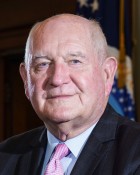
The Board of Regents named Dr. Sonny Perdue the 14th chancellor of the University System of Georgia effective April 1, 2022. He oversees 26 public colleges and universities with a more than $11.5 billion annual budget, 48,000 faculty and staff and more than 344,000 students.
The Georgia Public Library Service and the Georgia Archives are also part of USG, which has been recognized nationally for its efforts in cost savings and student attainment. The number of students annually earning degrees has increased 36% since 2011. And through support from initiatives such as Affordable Learning Georgia, students save over $49 million annually using no-cost and low-cost online educational resources.
Prior to becoming chancellor, Perdue was the 31st Secretary of the U.S. Department of Agriculture (USDA) from 2017 to 2021. He also served two terms as the governor of Georgia, from 2003 to 2011, and was a member of the Georgia Senate from 1991 to 2001, where he chaired the Senate Higher Education Committee and eventually became Senate President Pro Tem.
As Agriculture Secretary, Perdue managed a workforce of 110,000 employees with the stated objective of being the most efficient, effective and customer-friendly agency in federal government. This included stabilizing the food supply chain during the COVID-19 pandemic and launching the Farmers to Families Food Box program to ensure the most vulnerable Americans were fed.
As governor, he reformed the state budget and focused on eliminating wasteful spending while Georgia faced unprecedented twin recessions. His fiscal management during those eight years prepared Georgia to excel when revenues returned and allowed Georgia to maintain its Triple-A bond ratings. During his term, high school graduates in Georgia posted the highest graduation rates and SAT scores in state history.
His tenure in the state Legislature came at a time when lawmakers worked with Georgia Gov. Zell Miller to craft one of the most innovative higher education programs in the nation, the HOPE Scholarship. Perdue in his role as higher education chairman also helped recruit USG Chancellor Stephen Portch to Georgia. This work reinforced a passion for higher education that continues today, including a commitment to maintaining the connection between a world-class university system and economic success for the benefit of the state and all Georgians.
Born in Perry, Georgia, on Dec. 20, 1946, and raised on a farm in Bonaire, Perdue is a veterinarian and agribusiness owner who graduated from Warner Robins High School and earned his doctor of veterinary medicine degree from the University of Georgia. He is also a veteran, serving four years in the U.S. Air Force. He is married to the former Mary Ruff, also a UGA graduate. They have four children, 14 grandchildren and have served as foster parents for eight children awaiting adoption.
Functional Areas
- Academic Affairs
Academic Affairs promotes and ensures academic quality in the University System of Georgia. The various departments within Academic Affairs work closely with USG institutions to ensure that the citizens of Georgia can pursue further studies from a rich variety of high quality academic programs – undergraduate, graduate, and professional – to meet their interests and lifelong career needs.
- External Affairs
External Affairs promotes and advances the University System of Georgia by strategically communicating with the public and key stakeholders while also building partnerships in Georgia and beyond through the division’s work in communications, government relations and economic development.
- Fiscal Affairs
Fiscal Affairs handles the allocation of state appropriations to all University System of Georgia institutions, manages the internal administration of the university system office, and develops business procedures and practices for University System of Georgia institutions.
- Internal Audit
The Office of Internal Audit, Ethics & Compliance supports the University System of Georgia’s management in meeting its governance, risk management, compliance and internal control responsibilities while helping to independently and objectively enhance operational efficiency and effectiveness.
- Operations
The Operations Division provides direction and structure for business operations of the University System of Georgia. By establishing policies and overseeing day-to-day operations, it defines and evaluates solutions for USG objectives in the departments of Information Technology, Cyber Security, Real Estate and Facilities, Legal Affairs, Human Resources, Safety and Security, Leadership and Institutional Development, and Strategic Implementation.